The long-arm excavator reaches through Tallahassee’s sandy clay overburden, bucket teeth scraping against weathered limestone at roughly 15 to 20 feet. That sound tells you everything—this is not homogeneous coastal plain soil. The city sits atop the Floridan Aquifer system, where solution cavities and pinnacled rock are common within the upper Hawthorn Group formations. A deep excavation here means contending with erratic bedrock profiles, high artesian pressures, and the very real possibility of opening a conduit to a buried karst feature. Our team designs shoring and bracing systems specifically for these conditions, integrating CPT test data to map refusal depth variability before a single soldier pile goes in. The goal is a dry, stable cut that remains safe through the entire construction window, even during Tallahassee’s intense summer thunderstorm season, which delivers over 60 inches of rainfall annually to this 200,000-resident capital city.
In Tallahassee’s karst, a deep excavation design that ignores solution cavities is not a design—it is a gamble with the Floridan Aquifer.
Our approach and scope
Key design elements we address on every Tallahassee project include:
- Lateral earth pressure distribution on cantilever and anchored walls, calibrated to the site’s actual drained and undrained shear strength parameters.
- Global stability of the excavation base, particularly where a clay confining layer thins over solution-weakened limestone.
- Groundwater control sequencing to prevent piping or basal heave during the critical cut-down phase.
- Construction-stage finite element modeling that accounts for wall deflection limits adjacent to historic structures like the Florida Capitol complex.
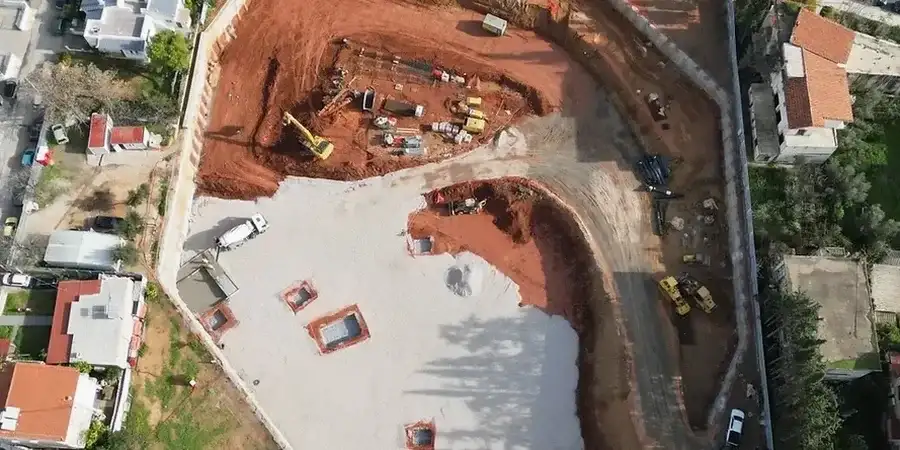
Local ground factors
ASCE 7 and the Florida Building Code require site-specific geotechnical investigations for any excavation deeper than 10 feet, but in Tallahassee the standard prescriptive measures often fall short. The combination of shallow groundwater, karst limestone, and a hurricane-prone wind zone creates a cascade of interdependent risks. Basal heave failures have occurred in the region when a thin aquitard was unknowingly penetrated, allowing artesian pressure from the Floridan Aquifer to blow out the excavation floor. Our design protocols explicitly evaluate the critical hydraulic gradient using Terzaghi’s heave analysis, and we specify real-time excavation monitoring with inclinometers and piezometers for cuts that extend below the water table. Another Tallahassee-specific concern is vibration-induced settlement: driving sheet piles near unreinforced masonry buildings in the Frenchtown or All Saints districts can trigger damage claims. We often specify drilled-in-place soldier piles or low-vibration installation methods to mitigate this risk from day one of the design phase.
Reference standards
ASCE 7-22 Minimum Design Loads and Associated Criteria for Buildings and Other Structures, IBC 2021 (Florida Building Code, 8th Edition) Chapter 18 – Soils and Foundations, ASTM D1586 Standard Test Method for Standard Penetration Test (SPT) and Split-Barrel Sampling of Soils, ASTM D2487 Standard Practice for Classification of Soils for Engineering Purposes, FHWA GEC No. 4 – Ground Anchors and Anchored Systems
Additional services
Excavation Support Design & Analysis
Full design of cantilever, anchored, and braced excavation systems using finite element and limit equilibrium methods. We deliver stamped construction drawings, staged dewatering plans, and wall deflection estimates calibrated to Tallahassee’s limestone-overburden stratigraphy.
Karst-Specific Dewatering & Stability Assessment
Evaluation of basal stability in pinnacled rock conditions, including assessment of artesian pressures in the Floridan Aquifer. We design wellpoint and deep-well dewatering arrays that lower the phreatic surface without destabilizing adjacent solution features.
Typical parameters
Questions and answers
What is the typical cost range for a geotechnical design package for a deep excavation in Tallahassee?
Design fees generally range from US$1,830 for a straightforward single-lot shoring analysis to US$8,900 for a multi-level braced excavation with staged dewatering and karst mitigation measures in downtown Tallahassee. The final cost depends on cut depth, proximity to adjacent structures, and the complexity of the groundwater control system required.
How do you handle karst limestone in an excavation design?
We combine closely spaced borings with geophysical methods like MASW to map the top-of-rock surface across the site. The design then accounts for steep rock pinnacles, soft clay-filled seams, and potential solution cavities. We specify probe drilling ahead of excavation if the geophysical data suggests a high risk of voids, and our tieback anchor designs assume variable bond lengths to ensure adequate pullout capacity in irregular rock.
What dewatering system works best in Tallahassee's high water table?
It depends on the cut depth and the permeability of the Hawthorn Group materials at your site. Shallow cuts in sandy clay can often be controlled with perimeter wellpoints spaced at 5 to 8 feet. Deeper excavations, especially those that penetrate into the limestone, may require deep wells or eductor systems. We model the drawdown radius and required flow rate for your specific stratigraphy to avoid over-pumping, which can destabilize nearby sinkhole-prone areas.