Drive across Tallahassee and the soil changes faster than the weather. Over in Killearn Estates, you'll find deep, well-drained Orangeburg sandy loams that make a spread footer look easy. But head south toward the Woodville Karst Plain, and suddenly you're dealing with the Hawthorn Group—sticky clays over weathered limestone, where a routine excavation can reveal a small sinkhole by Tuesday morning. That contrast is exactly why shallow foundation design here can't rely on generic bearing tables. The capital city sits at 200 feet of elevation on the Cody Scarp, a geologic boundary where the Red Hills transition to the coastal lowlands. This means one lot may support a traditional isolated footing while the next one over needs a stiffened slab-on-grade or even a mat foundation. We've pulled soil samples across Leon County where the top three feet looked textbook, but the underlying clay had a plasticity index above 40. For those tricky spots, pairing a shallow design with deeper investigation through test pits often reveals the full stratigraphy before the first yard of concrete is poured.
A shallow foundation on Tallahassee clay lives or dies by drainage—control the moisture, and you control the movement.
Our approach and scope
Local ground factors
The IBC requires that foundations be designed for the most critical condition, not the average one. In Tallahassee, the most critical condition is often a hidden solution cavity in the underlying limestone. The Floridan Aquifer dissolves the carbonate rock over decades, creating voids that can migrate upward and suddenly collapse, especially after heavy rains alter the groundwater pressure. A shallow foundation built without a ground-penetrating radar survey or a thorough test boring program might sit right on top of a raveling zone. The risk isn't theoretical—Leon County records dozens of sinkhole incidents annually. Beyond karst, the expansive clay risk is insidious; a slab designed for 1,500 psf bearing that doesn't include a moisture barrier or proper gutters can rack up repair costs exceeding the original foundation work within five years. That's why our designs always specify a positive drainage gradient away from the structure and often call for a capillary break beneath the slab.
Reference standards
IBC 2021 (Florida Building Code 8th Edition), ASCE 7-22 Minimum Design Loads, ASTM D2487 Unified Soil Classification System, ASTM D1586 Standard Penetration Test (SPT), ACI 332 Residential Concrete Requirements
Additional services
Spread Footing & Mat Foundation Design
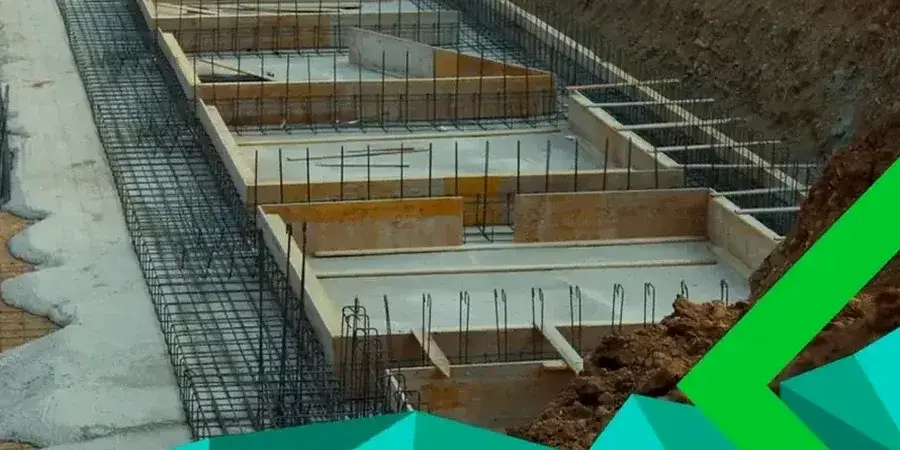
We size isolated and continuous footings for commercial and residential structures, modeling the load distribution through layered soil profiles. For poor soils or areas with potential karst activity, we design stiffened mat foundations that span small anomalies and reduce differential settlement risk, incorporating the subgrade reaction modulus from on-site plate load or SPT data.
Slab-on-Grade & Stiffened Slab Design
For residential and light commercial buildings, we design post-tensioned or conventionally reinforced slabs per PTI DC10.5 standards. Our process accounts for the Thornthwaite Moisture Index specific to the Tallahassee climate, specifying rib depth, tendon layout, and vapor barrier placement to mitigate the effects of expansive Hawthorn Group clays and seasonal moisture fluctuation.
Typical parameters
Questions and answers
What does a shallow foundation design package for a Tallahassee lot typically cost?
For a standard residential or light commercial site in Leon County, a complete shallow foundation design package—including bearing capacity calculations, settlement analysis, and construction-ready drawings—typically ranges from US$1,870 to US$3,280. The final figure depends on the complexity of the soil profile, whether we need to coordinate with a supplemental karst investigation, and the structural loads involved. You'll receive a fixed-fee proposal after we review your preliminary architectural plans and the existing geotechnical report, so there are no surprises once we begin the engineering work.
How do you handle foundation design on Tallahassee's expansive clays?
We start by quantifying the expansion potential through Atterberg limits and the Plasticity Index from your soil boring logs. For clays typical of the Hawthorn Group, we'll often specify a stiffened slab-on-grade with deepened perimeter ribs, a moisture-conditioned subgrade, and a solid drainage plan. In some cases, we recommend over-excavating the active zone and replacing it with engineered fill to create a stable moisture buffer. The key is preventing differential moisture changes beneath the slab over time, which is why we also detail requirements for gutters, downspouts, and site grading to keep water at least five feet from the foundation edge.
What geotechnical information do you need before designing a shallow foundation?
At minimum, we need a geotechnical report with SPT N-values, moisture content, and Atterberg limits from borings that extend to at least twice the width of the planned footing—or deeper if karst terrain is suspected. For sites within the Woodville Karst Plain, we strongly recommend a ground-penetrating radar (GPR) or electrical resistivity survey to screen for subsurface anomalies. If the report doesn't include a swell test, we'll often request a supplemental consolidated-swell test on the most plastic sample to confirm the expansion pressure. The better the input data, the more efficient the foundation design, and the less contingency you carry into construction.