The soil profile changes fast across Tallahassee. A site near Lake Jackson can hit organic silt at six feet, while a job just east of Capital Circle sits on dense sand over weathered limestone. That contrast means pile foundation design here cannot follow a generic template. Our lab runs the full ASTM D2487 classification on every boring before selecting pile type and depth. When we drilled a warehouse off Mahan Drive, the upper clay layer looked stable but the standard penetration test showed N-values dropping below 8 at fourteen feet — a textbook case for driven piles socketed into the underlying rock. For projects closer to the Florida Geological Survey’s mapped karst zones we combine pile design with a CPT test to catch solution cavities that SPT alone can miss.
Tallahassee’s Hawthorne Group clays lose up to 40% of their undrained shear strength when remolded — a sensitivity that dictates pile socket length on every job.
Our approach and scope
Local ground factors
The USGS Quaternary fault map shows the Gulf Trough runs just south of the Florida-Georgia line, and while Tallahassee is not in a high-seismicity zone, the IBC still assigns Leon County to seismic design category B. Combine that with the karst topography documented by the Florida Geological Survey in the northern half of the city, and you get a dual risk: sudden voids in the limestone and a design earthquake that can mobilize them. A pile driven into a thin rock cap over a solution cavity will not show failure during driving — it fails years later under service load. We have seen exactly that on a retrofit job near Lake Ella where three existing piles had settled two inches because they punched through into a mud-filled cavity that the original boring missed. That is why our pile foundation design in Tallahassee includes a mandatory karst probe for any site within 500 feet of a mapped sinkhole feature.
Video overview
Reference standards
IBC 2021 Chapter 18: Soils and Foundations, ASCE 7-22 Minimum Design Loads, ASTM D1586 Standard Test Method for SPT, ASTM D2487 Classification of Soils for Engineering Purposes (USCS), FDOT Standard Specifications Section 455
Additional services
Geotechnical Exploration for Pile Design
Boring program, SPT logging, rock coring, and lab testing to determine pile type, capacity, and embedment depth. Includes CPT where karst is suspected and cross-hole sonic logging for drilled shafts.
Pile Group Analysis and Structural Design
Axial and lateral capacity calculations per IBC and FDOT methods, group efficiency factors, settlement analysis, and construction specifications for driven or auger-cast piles.
Typical parameters
Questions and answers
What does pile foundation design cost for a Tallahassee project?
The full package — site investigation, lab testing, and pile design report — typically runs between US$1,700 and US$6,880, depending on number of borings, depth to competent rock, and whether karst probing is required. A single-family home on a standard lot falls at the lower end; a commercial building needing four borings and CPT verification sits at the upper end.
How deep do piles need to go in Tallahassee?
It depends entirely on the Hawthorne Group geology at your site. In the northern part of the city, competent limestone can appear at 25 to 40 feet; south of I-10, we sometimes drive piles to 60 feet or more to get past soft clay and into dense sand or rock. Every design starts with a boring log — we do not guess depths.
Do I really need a pile foundation for a two-story building in Tallahassee?
Not automatically. Many two-story structures on the sandy soils near Capital Circle work fine on shallow footings. But if your site has organic silt, loose sand with N-values under 10, or is within a mapped karst zone, piles become the safer choice. We make that call based on SPT data and lab classification.
What is the difference between driven piles and auger-cast piles for Tallahassee soils?
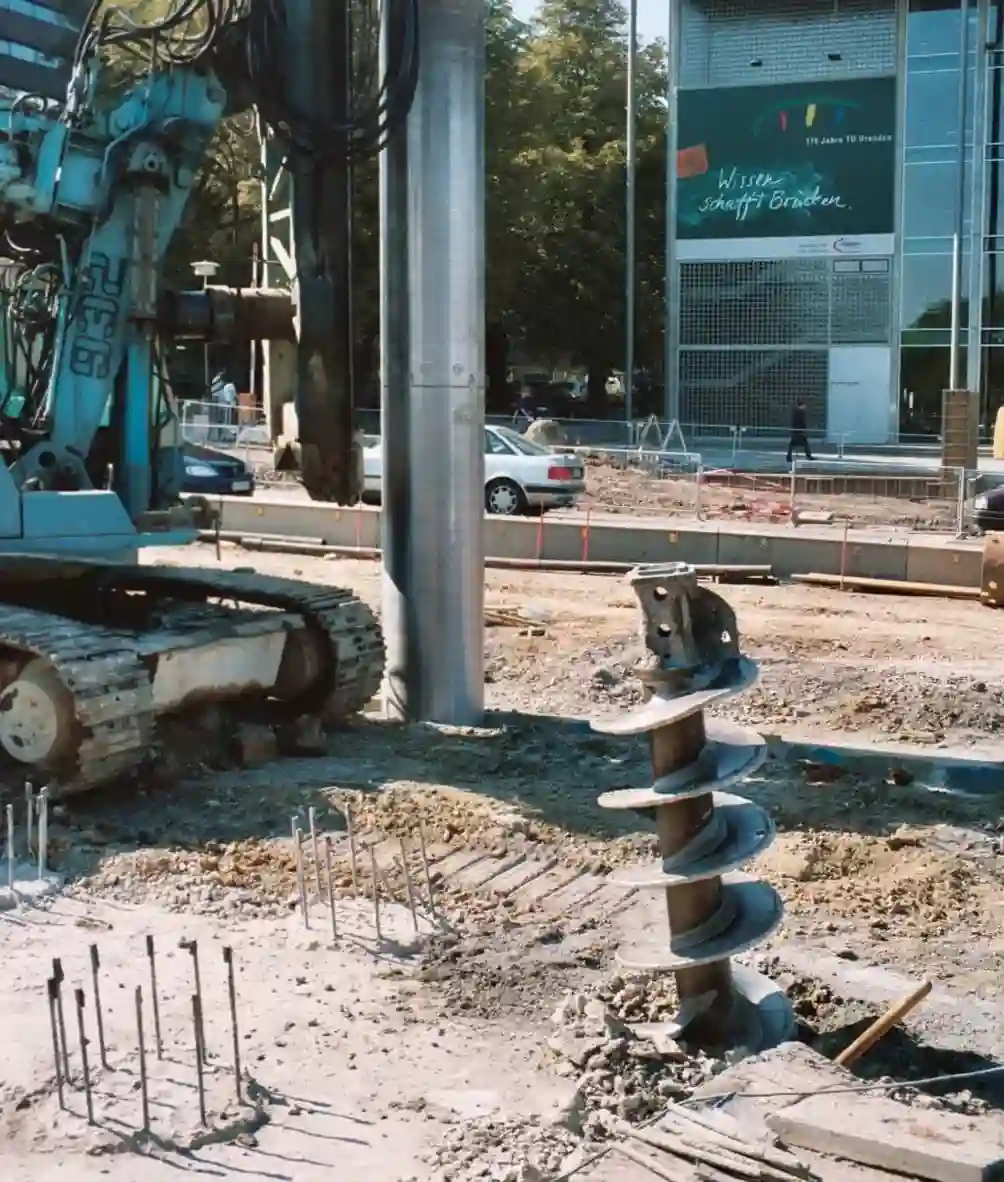
Driven piles displace soil and work well in the sandy layers common east of downtown; they compact the ground as they go. Auger-cast piles drill out the soil and are preferred when you need to case through soft Hawthorne clays without disturbing adjacent foundations or when vibration limits exist near existing structures.