Tallahassee’s development from a territorial capital into a modern city has pushed construction into the rolling terrain of the Red Hills physiographic region, where deeply weathered clays and silty sands dominate the near-surface geology. The city’s average elevation of 203 feet masks localized relief of 60 to 100 feet along drainageways like the St. Marks River basin, creating slope geometries that demand careful geotechnical attention. Many subdivision roads and commercial pads in the northeast quadrant sit on sidehill fill over residual Miocene sediments, a condition where pore pressure buildup during Florida’s 59-inch average annual rainfall becomes the critical factor. A test pit investigation provides direct observation of the fill-native interface and seepage zones that boreholes often miss, while a CPT sounding delivers continuous stratigraphy to identify thin, weak clay seams controlling the failure surface. Our slope stability analysis applies Spencer and Morgenstern-Price limit equilibrium methods calibrated to site-specific strength parameters obtained from advanced laboratory testing of undisturbed samples.
A slope that drains properly lasts decades. The same slope with uncontrolled seepage fails in one wet season—Tallahassee rainfall doesn't forgive poor drainage design.
Our approach and scope
Local ground factors
During construction of a three-story assisted living facility off Thomasville Road, the contractor cut a 28-foot near-vertical temporary face into weathered Hawthorn Group sediments to maximize the building footprint. The geotechnical report had recommended a 1.5H:1V temporary slope with a bench at mid-height, but the recommendation was ignored to save two weeks of earthwork. After a four-day rain event in July that delivered over eight inches of precipitation, a wedge failure released approximately 400 cubic yards of material, undermining a section of the perimeter storm drain and cracking the asphalt of the adjacent parking lot. The repair required soil nailing and a permanent soldier pile wall, delaying the project by eleven weeks and adding costs far beyond the initial earthwork savings. This case illustrates how slope stability in Tallahassee is primarily a rainfall-driven problem: the clay soils lose suction rapidly upon wetting, and the apparent cohesion that provides short-term stability disappears long before consolidation pressures can compensate.
Reference standards
ASCE 7-22 Minimum Design Loads and Associated Criteria for Buildings and Other Structures (Chapter 11, Seismic Design Parameters), IBC 2021 Section 1806 – Retaining Walls and Slopes, with Florida-specific amendments, ASTM D4767 – Standard Test Method for Consolidated Undrained Triaxial Compression Test for Cohesive Soils, FHWA NHI-05-123 – Soil Slope and Embankment Design (Reference Manual for Geotechnical experts)
Additional services
Limit Equilibrium Stability Modeling
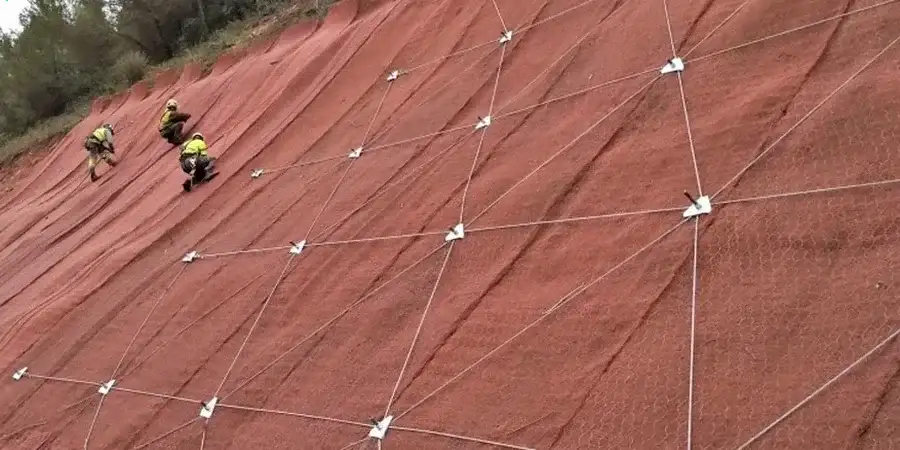
Two-dimensional circular and block-type analyses using Spencer and Morgenstern-Price methods. We model staged construction, rapid drawdown for pond embankments, and seismic pseudo-static conditions per IBC requirements for essential facilities in Leon County.
Reinforcement and Remediation Design
Design of soil nail arrays, ground anchors, and mechanically stabilized earth (MSE) slopes to achieve the target factor of safety. Specifications include corrosion protection class for the acidic, poorly-drained Tallahassee clays that accelerate metal loss.
Forensic Slope Failure Investigation
Post-failure back-analysis to determine the triggering mechanism and assign responsibility. operations include shear strength testing of the failure plane material, piezometer installation to map the post-failure groundwater regime, and expert witness testimony for litigation in Florida courts.
Typical parameters
Questions and answers
What triggers most slope failures in the Tallahassee area?
Rainfall is the dominant trigger. The Hapludult soils common in Leon County lose matrix suction rapidly during intense summer storms, reducing the apparent cohesion that holds cut slopes together. We design drainage systems—including horizontal drains and surface water diversion—to keep the phreatic surface well behind the slope face even during a 48-hour design storm.
How much does a slope stability analysis cost for a typical subdivision lot in Tallahassee?
For a single residential lot requiring a cut or fill slope evaluation, the analysis typically ranges from US$1,430 to US$3,780 depending on the slope height, the number of borings needed for stratigraphic definition, and whether laboratory triaxial testing is required versus using published correlations for the local Orangeburg formation.
Does Leon County require a slope stability report for building permits?
Tallahassee-Leon County Planning requires a geotechnical report addressing slope stability when the proposed grading creates a slope steeper than 2H:1V or exceeding 10 feet in height, or when the structure is located within a horizontal distance equal to the slope height from the crest or toe. The report must demonstrate a minimum static factor of safety of 1.5.
What is the difference between total stress and effective stress analysis for clay slopes?
Total stress analysis uses undrained shear strength (Su) and is appropriate for short-term conditions during and immediately after construction in saturated clays. Effective stress analysis uses c' and φ' and models pore pressure dissipation over time—it governs the long-term drained condition. For Tallahassee cut slopes in the Orangeburg clay, the drained effective stress condition almost always provides the critical failure surface because construction occurs during drier months but the slope must survive subsequent wet seasons.