Tallahassee’s geology isn’t what you’d expect for Florida. We’re not dealing with pure beach sand here. The Red Hills region brings a complex mix of Miocene and Pleistocene sediments—weathered clays, silts, and sands that can change completely within a few feet on the same lot. For any project near the Cody Scarp or east toward the St. Marks River basin, guessing the gradation curve isn’t an option. A complete grain size analysis—sieve plus hydrometer—tells us exactly how that material will behave under load, how it drains, and whether it’s suitable for compaction. When we run these tests in our lab, we’re looking beyond a number on a report. We’re checking if the borrow pit material matches spec before it’s trucked to a Tallahassee road widening, or verifying foundation subgrade for a new commercial build off Mahan Drive. Much of the local soil classifies as SC or CL under ASTM D2487, and getting that classification wrong can trigger differential settlement problems that surface two rainy seasons later.
Around Tallahassee, ignoring the silt and clay fraction in a gradation test can lead to foundation designs that underestimate settlement by half.
Our approach and scope
Local ground factors
A few years back, a Tallahassee contractor started earthwork on a subdivision near Buck Lake without running hydrometer analysis—they relied on a quick field sieve and visual classification. The material looked like decent sandy clay. After compaction and the first heavy summer rains, the pads developed localized settlement of nearly three inches in some spots. The post-failure lab testing showed the soil was actually a highly plastic silt with a fines fraction that had been completely missed. The fix required undercutting, select fill replacement, and recompaction—the cost ran well into six figures and delayed lot sales by four months. This happens more often than people admit. In Leon County, where the water table sits high and soils are residual from limestone weathering, the difference between a well-graded sand and a silty sand with poor drainage characteristics is invisible to the naked eye. The hydrometer catches it. Skip that step on a critical structure like a stormwater retention basin or a retaining wall, and you’re betting your project on a guess.
Reference standards
ASTM D6913 – Standard Test Methods for Particle-Size Distribution (Gradation) of Soils Using Sieve Analysis, ASTM D7928 – Standard Test Method for Particle-Size Distribution (Gradation) of Fine-Grained Soils Using the Sedimentation (Hydrometer) Analysis, ASTM D2487 – Standard Practice for Classification of Soils for Engineering Purposes (Unified Soil Classification System), AASHTO T 88 – Particle Size Analysis of Soils, IBC Chapter 18 – Soils and Foundations
Additional services
Standard sieving with hydrometer
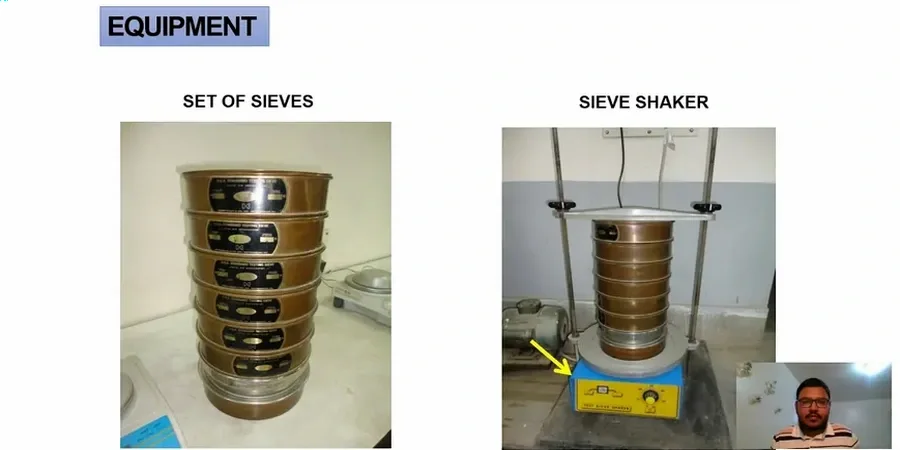
Combined ASTM D6913 and D7928 analysis providing the complete particle size distribution curve and USCS classification. We report D-values, coefficients of uniformity and curvature, and percent gravel, sand, silt, and clay. Turnaround is typically 2-3 business days for Tallahassee clients.
Particle size verification for borrow and fill
Routine gradation checks for borrow pit sources and compacted fill lifts during Leon County earthwork. We compare against project specifications and Florida DOT standard gradation bands, flagging any out-of-spec material before it creates a rejection issue.
Typical parameters
Questions and answers
Why do I need a hydrometer analysis if I already have sieve results?
Sieve results stop at the No. 200 sieve—they only quantify the total percentage passing, not the distribution of silt versus clay. In Tallahassee, many soils contain active clays that look like silt in a sieve test but behave very differently: they shrink, swell, and hold water. The hydrometer separates the silt and clay fractions so you get an accurate USCS classification and can predict drainage and volume change potential. Without it, a silty clay could be misclassified as a low-plasticity silt, and that mistake shows up in foundation cracks later.
How much sample material do you need for a full gradation test?
For a combined sieve and hydrometer analysis on typical Tallahassee sandy clay soils, we need about 500 grams of representative material. If the soil is predominantly fine-grained—heavy clay or silt—200 grams is usually sufficient. The sample must be in a sealed bag to preserve natural moisture if we’re also running Atterberg limits or moisture content on the same material. We can accept bag samples from your field crew or you can drop them at our receiving area during business hours.
What does a grain size analysis typically cost for a Tallahassee project?
A combined sieve and hydrometer test with full USCS classification generally runs between US$90 and US$210 per sample, depending on whether we’re running companion tests like Atterberg limits or specific gravity. Bulk pricing applies for larger earthwork programs—if you’re submitting more than ten samples from the same Tallahassee project, we can adjust the per-sample rate. We carry out a fixed quote before any work starts, no surprises.
How do you handle soils with organic content or unusual minerals?
Some Tallahassee sites near wetlands or former agricultural land produce samples with visible organic fibers or dark staining. We note that during logging and, if the organic content appears significant, we recommend an organic content determination before running the hydrometer. Organic material can skew the sedimentation readings because it doesn’t settle the same way mineral particles do. For soils with phosphate nodules—common in the Hawthorn Group—we crush them gently and note their presence in the report, since they can affect the gravel fraction percentages. More info.