The rig arrives with a hydraulic rotary head and triple-tube core barrels designed for soft formation sampling. In Tallahassee we deploy these specifically to capture undisturbed samples of the Hawthorne Group clays and the overlying residuum. Shelby tubes pushed through hollow-stem augers remain the standard for recovery in these sensitive soils. Each sample from the tunnel horizon undergoes careful extrusion and preservation on site. The field team logs moisture content changes immediately because Tallahassee’s high water table fluctuates with seasonal rainfall across the Cody Scarp. Losing saturation data means misreading effective stress. Before the drillers move to the next location we often specify a CPT test to fill gaps between boreholes, especially where the limestone caprock is unpredictable and core recovery drops below 50 percent.
Tunneling through Tallahassee’s karst residuum demands more than standard soil parameters—we target the exact horizon where clay transitions to weathered limestone.
Our approach and scope
Local ground factors
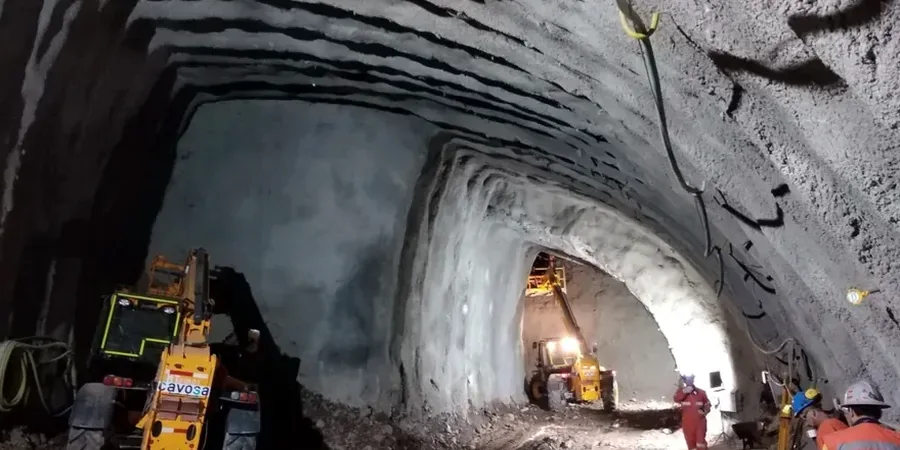
Tallahassee sits at roughly 200 feet above sea level with a karst geology that has produced sinkholes exceeding 30 feet in diameter within city limits. A tunnel boring machine advancing through the Hawthorne Group encounters abrupt transitions where competent clay gives way to solution-weakened limestone riddled with mud-filled cavities. Face instability occurs rapidly and without surface warning. The second threat is groundwater—pumping tests in the Floridan aquifer system show transmissivity values that can generate inflows exceeding 500 gallons per minute into an open excavation. An unplanned encounter with a water-bearing conduit at the tunnel face turns a routine advance into an emergency overbreak situation. Our pre-construction soft ground tunnel investigation protocol maps these features with closely spaced borings and cross-hole seismic tomography along the alignment. Every cavity we miss before the TBM launch becomes a potential collapse during mining.
Reference standards
ASTM D1586 (Standard Penetration Test), ASTM D2487 (Unified Soil Classification), IBC 2021 Chapter 18 (Soils and Foundations), ASCE 7-22 Section 20 (Site Classification), ASTM D4767 (Consolidated Undrained Triaxial)
Additional services
Karst feature delineation
Rotary wash borings with continuous SPT sampling at 2.5-foot intervals along the tunnel alignment. We log cavity depth, infill material type, and rock recovery. Where N-values drop below 2, we add cone penetration testing to define the softened zone geometry.
Laboratory strength and consolidation
Unconsolidated-undrained and consolidated-undrained triaxial tests on Shelby tube specimens from the tunnel horizon. One-dimensional consolidation testing per ASTM D2435 provides Cc, Cr, and Cv values for settlement prediction under the TBM face pressure.
Groundwater monitoring and inflow assessment
Installation of nested piezometers at tunnel depth with data loggers recording hourly fluctuations through a full wet-dry cycle. Constant-head permeability tests in the field combined with lab falling-head tests on intact specimens yield the hydraulic conductivity profile for inflow modeling.
Typical parameters
Questions and answers
What does a soft ground tunnel analysis cost in Tallahassee?
A full investigation program—including borings, lab testing, and a geotechnical baseline report—runs between US$4,640 and US$15,730, depending on the number of boreholes and the length of the tunnel alignment.
Which ASTM standards apply to tunnel design in Florida?
ASTM D1586 governs SPT sampling, ASTM D2487 defines soil classification, and ASTM D4767 covers consolidated-undrained triaxial testing. For rock core logging we follow ASTM D6032. The IBC and ASCE 7 carry out site classification and seismic design parameters.
How many borings are needed for a tunnel in karst terrain?
We typically space borings at 50 to 100 feet along the alignment, with alternating SPT and core holes. In Tallahassee south of the Cody Scarp where cavities are common, we tighten spacing to 25 feet and add resistivity lines to image voids between boreholes.